The best plans to discover Barcelona coast
Flights to Barcelona-El Prat Airport (Barcelona coast)

Getaway to the Coast of Barcelona
Get ready to discover the vibrant energy of this incredible coastal region and all it has to offer. At Nativics we have created this perfect getaway to spend a few
1 night

Hotels in Barcelona Coast
Do you dream of a perfect vacation on the Barcelona Coast? From Nativics we propose an unforgettable trip full of sun, beach, culture and fun, with the freedom of Design
1 night
Let's prepare your trip to Barcelona coast
Fill out this form and we will send you a personalized quote. It will only take you 1 minute.Who are you planning to travel with and on what dates?
Do you need flights to get to Barcelona coast?
How do you prefer to get around in Barcelona coast?
Which board do you want in your accommodation?
What is your maximum budget per person?: 300€
Is there anything else we should know?
Your data
You almost have it! Tell us your information so that we can contact you and send you your travel budget.Log in to retrieve your data or fill it in manually
By submitting this form you are accepting our Privacy policy
What to see in Barcelona coast?
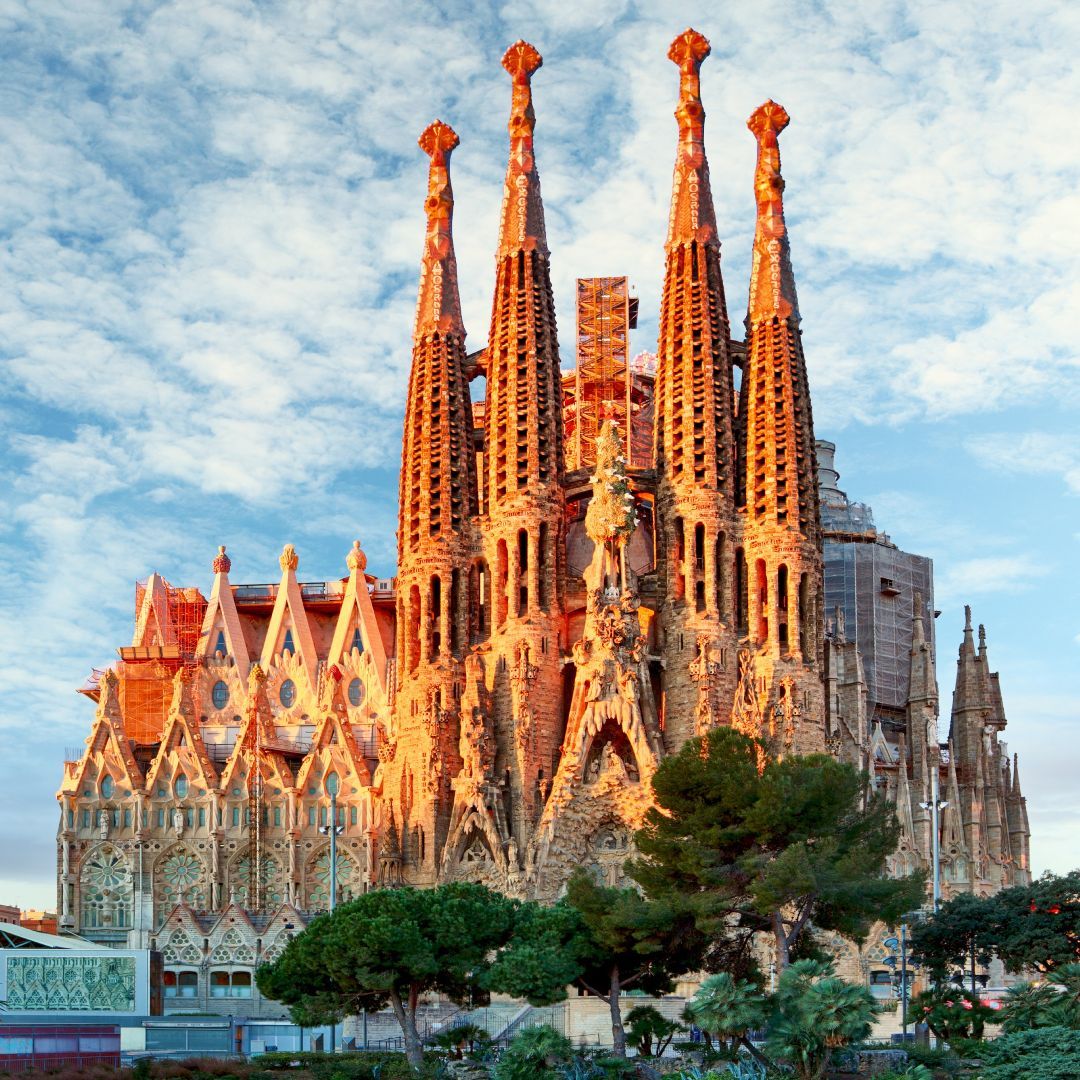
The Sacred Family of Barcelona
The Sagrada Familia is an exceptional temple located in the city of Barcelona, in the Spanish autonomous community of Catalonia. This Catholic basilica is a design and masterpiece by the architect Antoni Gaudí as well as the greatest exponent of Catalan modernist architecture. It is one of the most visited monuments in Spain and the most visited European church after Saint Peter's Basilica, even though it is still under construction after more than 140 years. Still unfinished, its magnitude and great beauty can already be appreciated both in the bell towers and in its façade and inside the temple, which can be accessed. The Sagrada Familia has a Latin cross plan, five central naves and an apse with seven chapels. It has three facades: the Nativity, the Passion and the Glory of Jesus and, when the construction is finished, it will have a total of 18 towers, two sacristies and three large chapels as well as a cloister. Undoubtedly, a great architectural work of Catalan modernism and a symbol of Barcelona that highlights the great Catalan artist, Antonio Gaudí and a must-see.
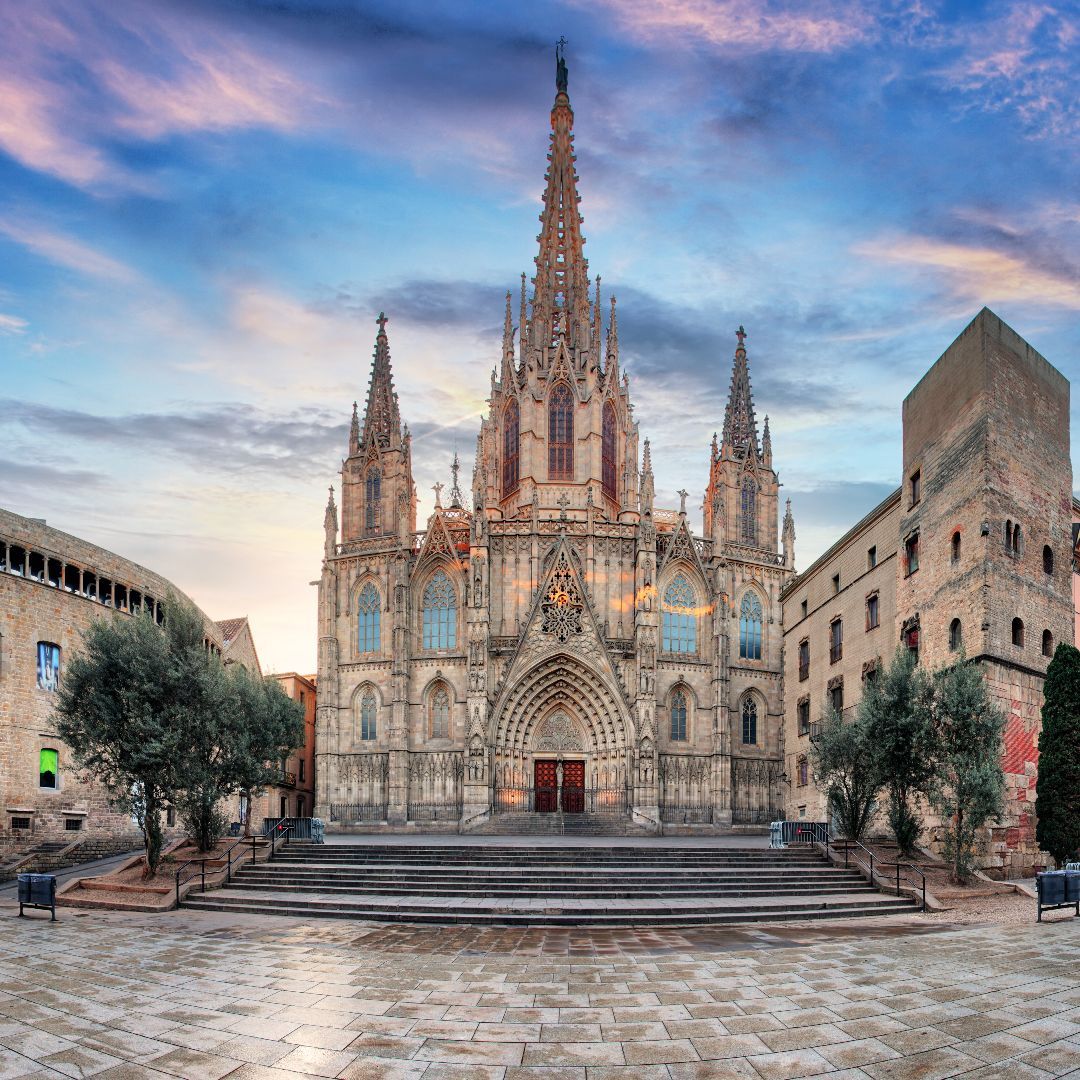
Barcelona's cathedral
The Barcelona Cathedral is located in the Gothic Quarter of the city of Barcelona. Its construction began in 1046 on the primitive cathedral that was heavily damaged by the attack of the Arab leader, Almanzor. On top of the foundations of the primitive early Christian basilica and that of the later Romanesque cathedral, the current Gothic cathedral was built. This temple has three naves with a single apse and ambulatory and measures 93 meters long, 40 meters wide and 28 meters high in the central nave. The dome has a height of 70 meters outside and 41 meters inside. Inside the cathedral there are several Gothic altarpieces made by Guerau Gener, Lluís Borrassà, Gabriel Alemany and Bernat Martorell as well as other Gothic paintings by Pere Destorrents, Jaume Huguet or Bartolomé Bermejo, author of the Pietà. This cathedral is also known as the Cathedral of the Holy Cross and Saint Eulalia, its official name, and is one of the places of tourist and cultural interest for those who travel to Barcelona.
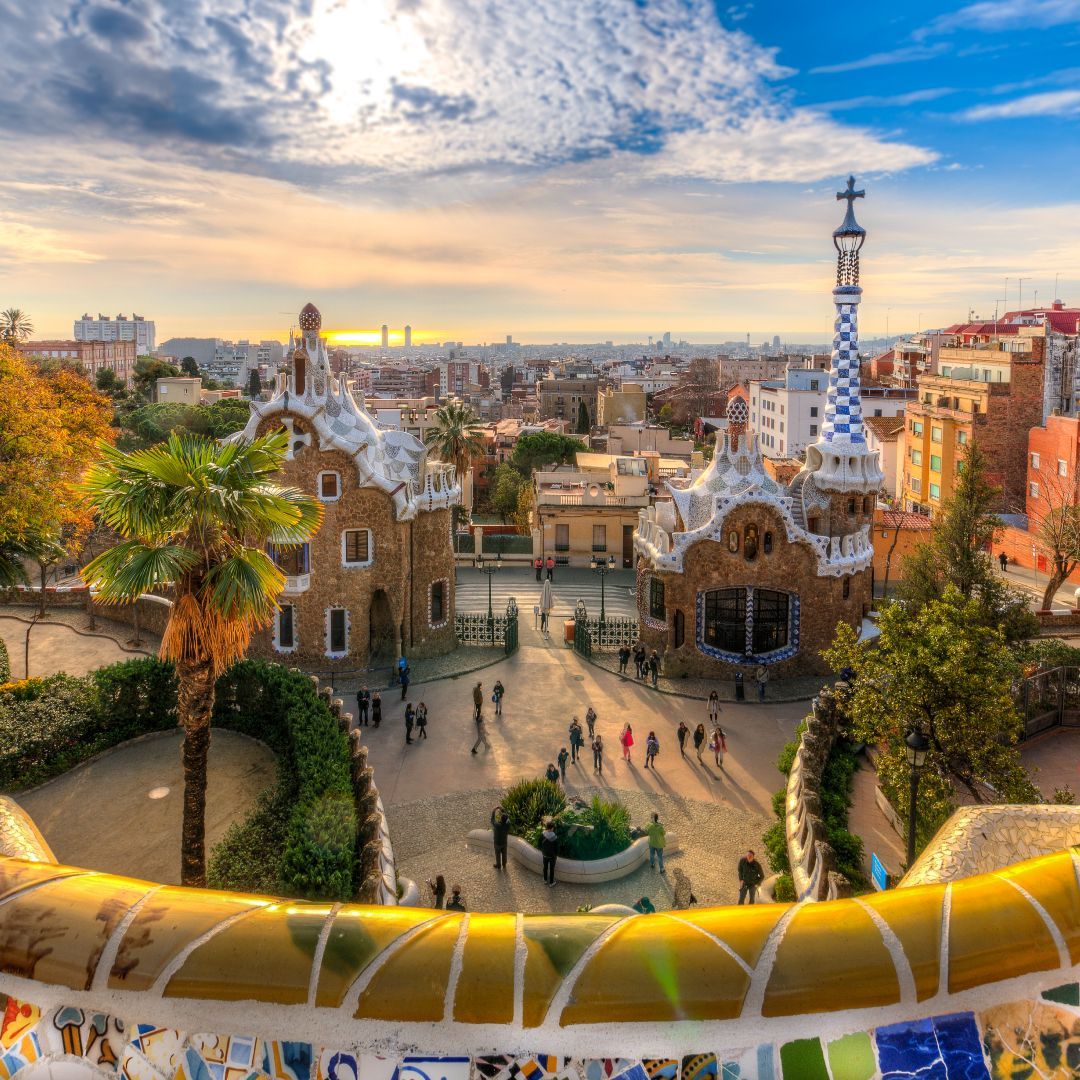
Park Guell
Park Güell is a 17-hectare public park located in Barcelona, in the district of Gracia, next to the Sierra de Collserola. This park has two large areas: the monumental area, declared a World Heritage Site, and the forest area. What makes Park Güell unique is precisely the monumental part, an entire architectural work of Catalan modernism carried out by the great master and genius, Antonio Gaudí. This monumental area occupies 12 hectares in which are the famous little houses that look like gingerbread and chocolate. This park began in 1900 on behalf of Eusebio Güell, son-in-law of the Marquis of Comillas, who had already commissioned several constructions from his good friend Gaudí. Güell's intention was to make a private urbanization with a green area that simulated British residential parks, hence the name of the park is in English (Park Güell). The complexity for the sale of the plots and the exclusive nature of the urbanization made it unfeasible, building only two houses of the sixty that had been planned. In this way, instead of a residential area, the park became a large private garden that Güell gave up for public events. After his death in 1918, his heirs offered the park to Barcelona City Council, who bought it in 1922 and opened it as a municipal park. The house of the Güell family became a public school and Gaudí's house has been a House Museum since 1963. In 1969 Park Güell was recognized as an artistic monument and declared a World Heritage Site by UNESCO in 1984. Without a doubt, this park is the pride of Barcelonans and a must-see for those who travel to Barcelona. Gardens, a large square, colorful houses, columns... It is probably one of the most beautiful parks in the world. Don't miss out!
Gothic Quarter
The Gothic Quarter or Barri Gòtic, is a neighborhood of Barcelona located in the center of the city, in the Ciutat Vella district. It is the oldest center of Barcelona and one of the most acclaimed areas for its medieval alleys, where the Barcelona Cathedral and numerous bars, pubs and restaurants are located. Among its places of interest are also: the Pont del Bisbe; the Barcelona History Museum, in Plaza del Rey; the Colón viewpoint, from where you can see the Gothic quarter from above; the Basília de Santa María del Pi and the parish of Santa Ana. In addition, this neighborhood is bounded by Las Ramblas, Vía Laietana, Paseo de Colón and Plaza Cataluña, making it a point of reference and a place from where you will get to know all the city.
The Rambla of Barcelona
La Rambla or Ramblas de Barcelona, is one of the most visited places in Barcelona. This emblematic promenade is located in the heart of the city and is 1.3 km long, connecting the old port of Barcelona with the famous Plaza Catalunya. Barcelona's Rambla is always very busy and lively and you can find everything from newsstands, souvenirs and flowers, to bars, restaurants, painters and human statues in the most elaborate costumes. If you travel to Barcelona, Las Ramblas is a must-see that, in addition, will allow you to discover some of the points of interest in its surroundings, such as the Boquería Market, the Gran Teatro Liceo, the Güell Palace, the Plaza Real, the Mirador de Colón or the Barcelona History Museum. Nearby is also the Gothic Quarter and the Barcelona Cathedral.
Camp Nou
Camp Nou is the football stadium of Fútbol Club Barcelona, one of the best and most recognized Spanish teams in the world. This sports venue is located in the district of Les Corts, in the city of Barcelona, in the Spanish autonomous community of Catalonia. It was inaugurated on September 24, 1957 and has a capacity of 99,354 spectators, making it the European football stadium with the largest capacity and the third in the world. Its name, Camp Nou, means New Field and is due to the fact that it was this stadium that replaced the previous one and that it was too small for the large number of club fans and visitors. The Camp Nou has a maximum height of 49.67 meters and an area of 58,760 m². The field of play, obviously following UEFA regulations, is 105 meters by 68 metres. In the 1998-99 season, it was UEFA itself that classified this soccer field as a Five-Star stadium for its services and functionality and, in 2010, it was replaced by Category 4, which is awarded to stadiums that meet the maximum demands in services and capacity. Among the facilities inside the Camp Nou are the boxes, the VIP room, the press room, a small chapel, the changing rooms, the technical services offices, several television sets and press booths, the Sports Medicine Center, the Operational Control Unit, the premises of the Barça Players Association and the FC Barcelona Museum.
Montjuic cable car
The Montjuïc cable car is one of the most special ways to discover the city of Barcelona, Spain. This funicular has a route of 750 meters that will allow you to see the Sagrada Familia, the Camp Nou and the Magic Fountain of Montjuïc from above. The Montjuïc Cable Car route starts at Parc de Montjuïc and ends at Montjuïc Castle.
Casa Batllo
Casa Batlló is an architectural work of the great master Antonio Gaudí. Also known as Casa dels ossos (House of Bones), due to its original architecture, Casa Batlló is located in the center of Barcelona, specifically at number 43 Passeig de Gràcia, in the Eixample district. Built between 1904 and 1906, it currently receives visitors from all over the world who come to contemplate this building, which is an example of Catalan modernist art and a faithful representation of Gaudí's creativity and genius. Although the main attraction of Casa Batlló is its impressive façade, visits to the interior are also allowed by purchasing the entrance ticket. Casa Batlló is open 365 days a year and can be visited from 9:00 a.m. to 9:00 p.m.
La Pedrera - Casa Mila
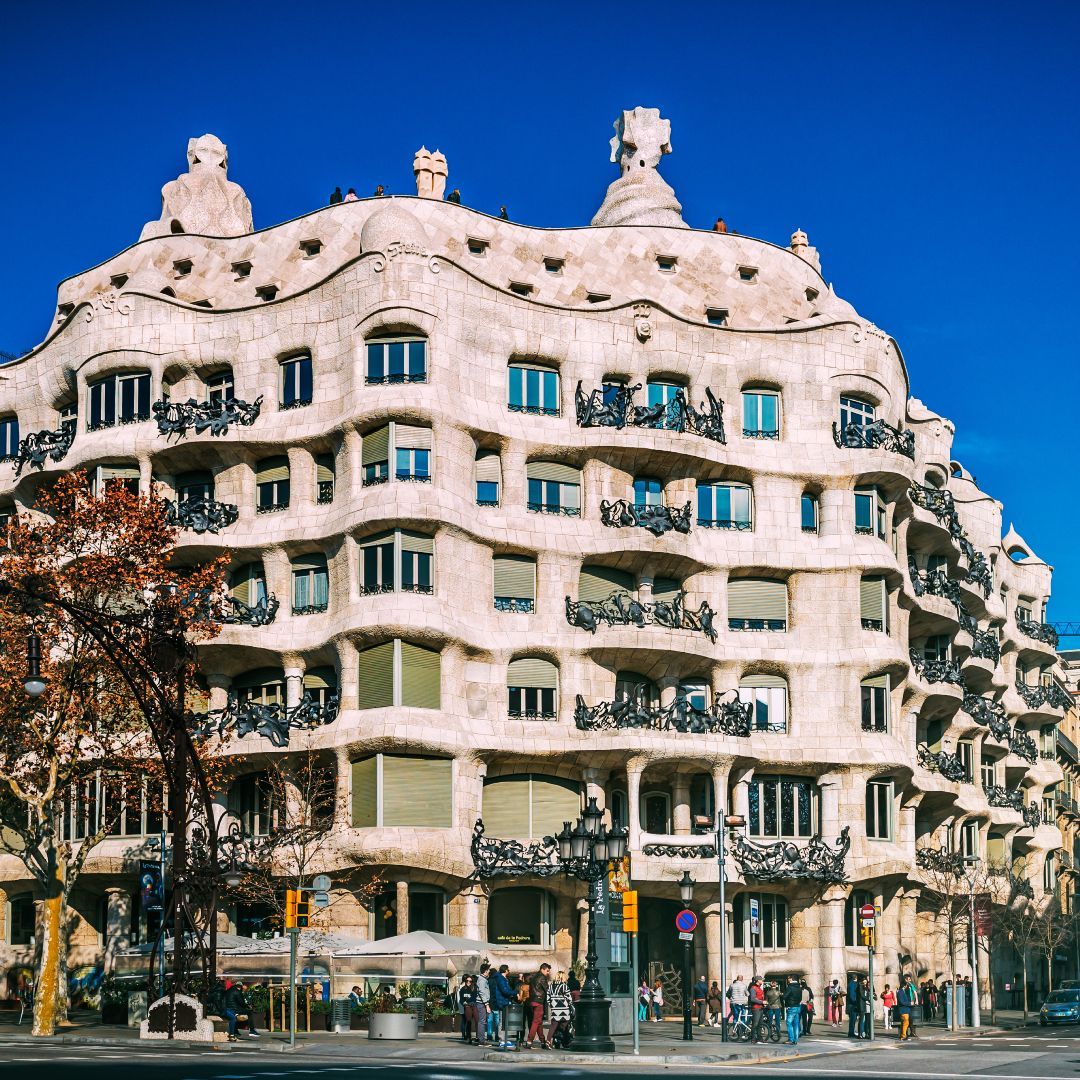
La Pedrera or Casa Milà, is a building designed by the great Spanish master Antoni Gaudí located in the center of Barcelona, on Paseo de Gracia, cataloged as a World Heritage Cultural Asset by UNESCO. Its construction was carried out between 1906 and 1912, being one of the most innovative civil works of the Catalan architect. This building stands out for its façade, which is neither structural nor a load-bearing wall, but rather becomes a curtain wall where more than 6,000 stone blocks are joined to the structure by metallic elements. The forge is another of its distinctions both as an architectural complement and as an ornamental contribution.Over the years, this building has accommodated distinguished guests - including a prince and his entourage -, it has been a hotel, headquarters of a consulate, bingo, company offices and shops. Its construction was commissioned by the marriage formed by Pere Milà and Rosario Segimon, hence it is known by the name of Casa Milà. The intention of this couple was to create a unique building in which to stay on the main floor while they rented the rest of the houses. After some complications with the building permits, in 1912 the end of the works on the building was certified, thus settling the Milà couple and renting the rest of the houses. In 1929, the first store in La Pedrera was installed, on the ground floor of the building, the Mosella tailor shop. During the Spanish Civil War, 1936-1939, Casa Milà was confiscated by the Unified Socialist Party of Catalonia (PSUC), becoming the headquarters of the Ministry of Economy and Agriculture and the private residence of the minister Joan Comorera who settled on the main floor. In 1940 Pere Milà died and his widow, Rosario Segimon, six years later, in 1946, sold the building to the Provenza real estate company with the condition that they continue to live on the main floor until his death in 1964. In 1953, this real estate company commissioned to the architect Francisco Juan Barba Corsini the construction of 13 apartments in the attic of the building and the transformation of the first floor on Provenza Street into four apartments of more than 100 m² each, giving us an idea of the dimensions of the building. In 1986 the Caixa de Catalunya bank bought the building from the Provenza Real Estate. In 1987 the visit to the roof of La Pedrera was opened for the first time and the building was restored to turn it into a cultural center. In 1992, the exhibition hall was inaugurated with the exhibition Avant-garde in Catalonia, forming part of the cultural program of the 1992 Olympic Games. IN 1994, the La Padrera auditorium was inaugurated in the old garages of the building . Finally, in 1996 the restoration works were completed under the motto "For Barcelona we do not give a grain of sand but an entire Pedrera".
Sant Pau Modernist Enclosure
The Sant Pau Modernist Complex is a building of historical and architectural interest, a World Heritage Site and a masterpiece of Catalan modernism. Located on Gaudí Avenue in Barcelona, this site is the most famous work of the architect Lluís Domènech i Montaner and, originally, it housed the Hospital de Sant Pau, which was maintained until 2009. The idea of creating this hospital was to make it a place beautiful, with natural light and surrounded by nature to achieve a healthy and peaceful environment for the sick. Large in size, this surface has different pavilions and a huge garden area. It is currently a center of knowledge and the different pavilions have become the headquarters of institutions in the fields of health, education and sustainability. In addition, the Modernist Enclosure of Sant Pau, declared a World Heritage Site by UNESCO, is part of the Modernisme route and visits to the complex and the exhibitions are allowed.
Port Vell of Barcelona
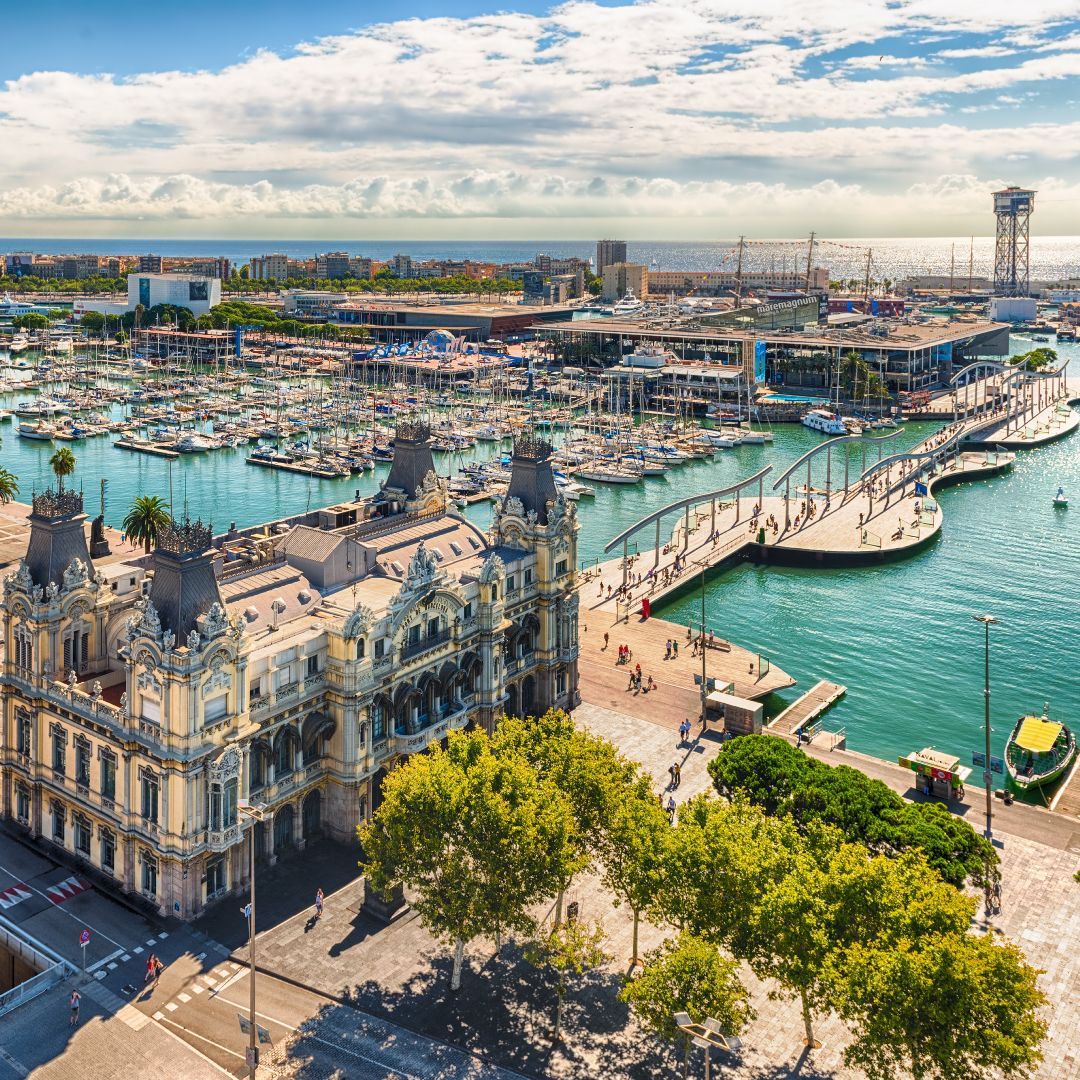
The Port Vell (Old Port) is the oldest in Barcelona. Before it was frequented by sailors but now it is a place of leisure where you can find the Maremagnum shopping center with shops, bars and restaurants, the Barcelona Aquarium, a 3D cinema and a lively atmosphere. The Port Vell is located at the end of the Rambla, next to the Columbus monument, in the Plaza Portal de la Pau.
Paseo del Borne (Barcelona)
The Paseo del Borne - or Passeig del Born, in Catalan- is an old medieval promenade located in the Ribera neighborhood, between the old Born market and the Santa María del Mar church, in the Ciutat Vella district , in Barcelona (Spain). In earlier times, parties, fairs, tournaments and medieval jousts were held along it. In the 16th century the Spanish Inquisition also used it to execute those who went against it. Along this pedestrian promenade, there are numerous constructions declared as a Cultural Asset of Local Interest. In addition, the passeig del Born is a meeting place, leisure and nightlife. Terraces, bars, restaurants and shops fill its streets.
prev
next